


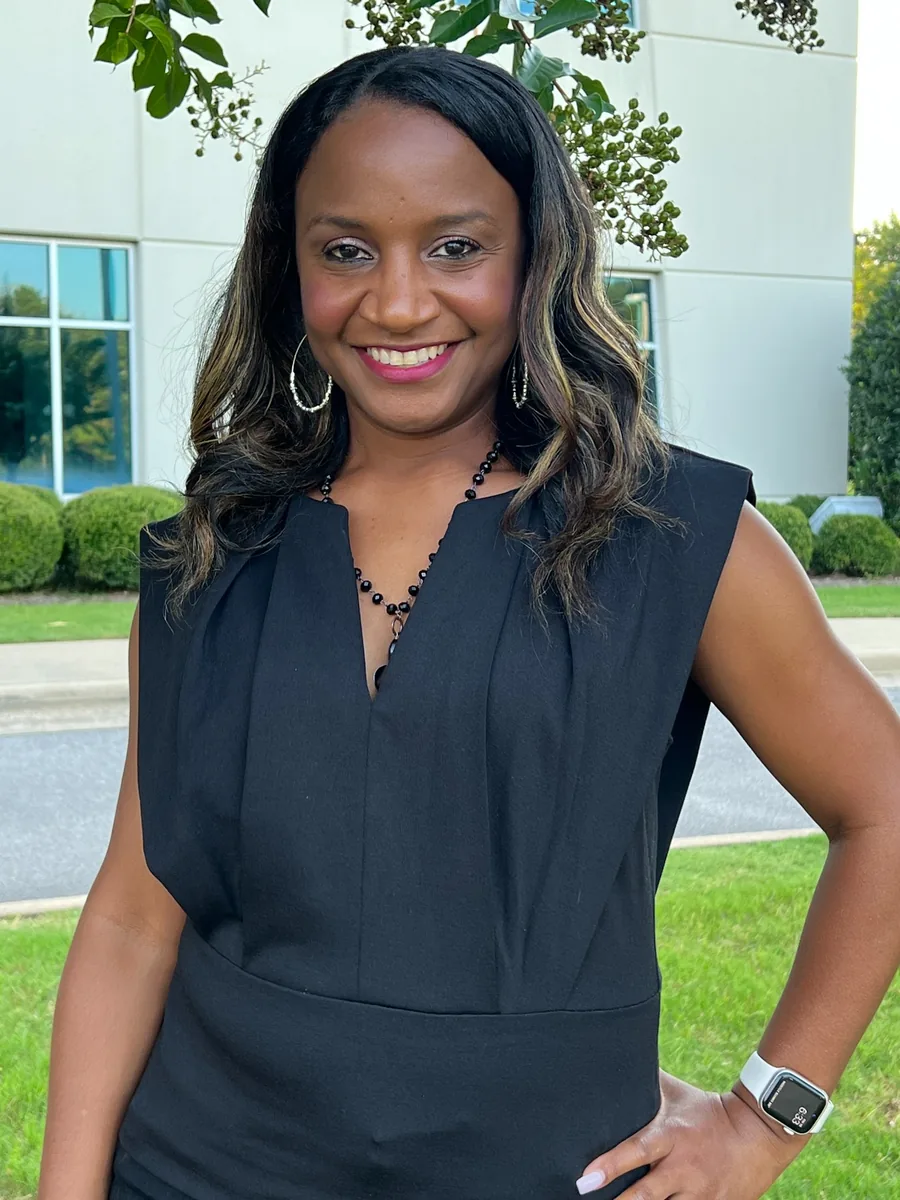
From the moment you meet Nikara McNeely, you are struck by her beautiful smile and personable spirit. A wife and mother of two, Nikara also has a career she is deservedly proud of. She works for the Department of Homeland Security as a Legal Administrative Specialist after spending more than a decade with the Drug Enforcement Administration (DEA) as an investigator and group supervisor. Born and raised in Birmingham, Alabama, Nikara graduated from Tennessee State University and returned home to begin her career.
During a routine eye exam shortly before her wedding — and just before leaving for DEA training at Quantico — Nikara was diagnosed by Dr. Tyler Hall at UAB Callahan Eye Clinic with Fuchs dystrophy, a disease of the cornea. At the time, the diagnosis didn’t feel particularly urgent. Nikara had a wedding, a new career and a move ahead of her, so she continued with her plans. A few years later, while living in Tulsa, Oklahoma, she began experiencing floaters and other changes in her vision. A doctor there reminded her that eventually Fuchs dystrophy would become something she could no longer ignore.
Several years later, Nikara and her husband had two children and had moved back to Birmingham for her work with the DEA. One morning Nikara woke up and couldn’t see clearly. She describes the blurriness as looking at a television news interview in which someone’s face has been intentionally obscured. Frightened and unable to see the numbers on her phone, she used Siri to call a friend who helped calm her and encouraged her to contact her doctor. Eye drops and then a prescription gel provided little improvement. Nikara had reached what she describes as “a moment of complete surrender.”
She was referred for the next level of treatment — and found herself back with Dr. Hall, the physician who had first diagnosed her years earlier. This time, the next step was a cornea transplant. Nikara’s thoughts immediately went to her career and, even more importantly, her children, who were 7 and 10 at the time. “What if this doesn’t work?” she remembers wondering. “What about my job? The essence of my job is to pay attention to and catch specific details. And what about my children? I can’t be the parent I need to be and teach my children the things they need to learn from me if I can’t see.”
Nikara received a transplant in her right eye and will eventually need one in her left. She later learned that others on her father’s side of the family have also lived with Fuchs dystrophy and required corneal transplants.
Today, Nikara becomes emotional when she thinks about the person whose decision to donate made her transplant possible. “If it wasn’t for someone intentionally giving as a donor,” she says, pausing, “they chose to give me and my family a future.” She believes many people think first about hearts, kidneys and other organs when they hear the word donation, without realizing that donated eye tissue can also profoundly change another person’s life.
Nikara also knows there are fears and misconceptions about donation, saying, “And in our community, there is a fear that if you become a donor that your donated organs will be taken before you are gone. It is important to become educated about the truth and learn what a difference you can make in someone’s life by becoming a donor.” For Nikara, that difference extends far beyond restored sight.
“The impact of this decision lasts long after the choice is made. It actually impacts generations,” Nikara says. “When I think about how I am able to pour into my children today — in a way I wouldn’t have been able if not for my transplant surgery, my donor has actually impacted many generations. How I am a mother to my children today will influence how they parent their children in generations to come.”
One donor’s decision gave Nikara the opportunity to see more clearly again. But to Nikara, the gift is even greater: her donor helped shape a future for a family the donor would never meet, with an impact that may be felt for generations to come.